What is a Perforated Aluminium Sheet?
The world of modern architecture and industrial design is always looking for materials that are strong, lightweight, and beautiful. One material that stands out is the perforated aluminium sheet. From the sleek walls of city skyscrapers to the ventilation systems in factories, this versatile material is everywhere.
What Exactly is a Perforated Aluminium Sheet?
At its simplest, a perforated aluminium sheet is a piece of aluminium plate that has been manually or mechanically stamped or punched using CNC technology to create a pattern of holes, slots, or decorative shapes.
Unlike solid metal sheets, perforated panels allow for the passage of light, air, and sound while maintaining the structural integrity of the metal. Because it is made of aluminium, the sheet is naturally resistant to rust and much lighter than steel or copper.
Key Characteristics of Perforated Aluminium
- Lightweight: Aluminium has a low density (ρ≈2.7g/cm3), making it easy to install.
- Corrosion Resistance: It forms a natural oxide layer that protects it from the elements.
- High Strength-to-Weight Ratio: It provides excellent protection without adding too much weight (W) to a building.
- Recyclability: It is an eco-friendly material that can be recycled infinitely.
How Are Perforated Aluminium Sheets Made?
The manufacturing process has evolved from simple manual punching to high-precision digital fabrication.
1. CNC Punching
This is the most common method. A machine uses a “punch and die” set to press holes into the sheet. It is fast and cost-effective for standard patterns like round or square holes.
2. Laser Cutting
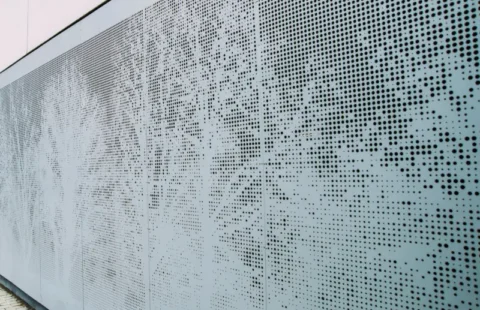
For complex designs or artistic patterns, laser cutting is used. It uses a high-powered laser (P) to melt the metal with extreme precision. This is ideal for “image perforation” where the holes create a picture.
3. Waterjet Cutting
Used for very thick aluminium sheets where heat from a laser might warp the material. It uses high-pressure water mixed with abrasive minerals.
Technical Specifications and Hole Patterns
When ordering a perforated aluminium sheet, you need to understand the technical details. These factors determine how the sheet will perform.
Common Hole Shapes
| Hole Type | Best Use Case | Visual Style |
|---|---|---|
| Round Holes | Ventilation, filtration, and standard cladding | Classic and balanced |
| Square Holes | Maximum airflow and high visibility | Modern and bold |
| Hexagonal Holes | High open area, often used for car grilles | Technical and “honeycomb” look |
| Slotted Holes | Sorting materials or drainage | Industrial and functional |
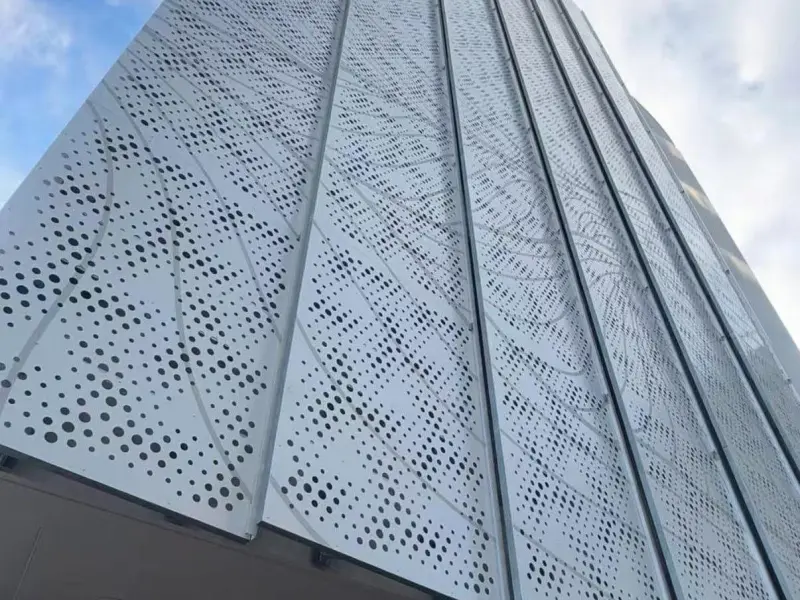
| Decorative | Architectural facades and interior branding | Artistic and unique |
Understanding the “Open Area” Percentage
The “Open Area” (Ao) is the most important technical stat. It tells you how much of the sheet consists of holes. For example, a panel with 40% open area means 40% is air and 60% is metal.
For a standard staggered round hole pattern, the formula used by engineers is:
Ao=p2d2×90.69
Where:
- d = hole diameter
- p = pitch (center-to-center distance between holes)
Top Applications of Perforated Aluminium Sheets
Because they are both functional and decorative, these sheets are used across many industries.
1. Architectural and Construction
- Exterior Cladding: Creating a “breathable” skin for buildings.
- Sunshades: Blocking direct sunlight to reduce heat (Q) while keeping the view.
- Balcony Railings: Providing privacy without blocking the breeze.
- Ceiling Panels: Hiding pipes and wires while looking sleek.
2. Industrial and Manufacturing
- Filtration: Separating liquids from solids in chemical plants.
- Machine Guards: Protecting workers from moving parts while allowing visibility.
- Grain Dryers: Allowing air to flow through agricultural silos.
3. Interior Design and Furniture
- Acoustic Panels: When backed with insulation, perforated sheets help absorb sound (dB).
- Lighting Fixtures: Creating beautiful shadows and light diffusion.
- Retail Displays: Lightweight shelving and pegboards for shops.
Popular Aluminium Alloys for Perforation
Not all aluminium is the same. Depending on your project, you will need a specific alloy.
| Alloy Series | Strength Level | Key Features |
|---|---|---|
| 1000 Series | Low | Pure aluminium, very soft, excellent corrosion resistance. |
| 3000 Series | Medium | Mixed with manganese. Great for general construction (e.g., 3003 alloy). |
| 5000 Series | High | Mixed with magnesium. Excellent for marine environments (e.g., 5005 or 5052). |
| 6000 Series | Very High | Heat-treatable. Used for structural frames (e.g., 6061 alloy). |
Surface Finishes and Coatings
To make the perforated aluminium sheet last longer and look better, several finishes can be applied:
- Mill Finish: The raw metal look as it comes from the rolling mill.
- Anodizing: An electrochemical process that thickens the natural oxide layer. It makes the surface harder and adds a metallic tint (like bronze or gold).
- Powder Coating: A dry powder is sprayed on and baked. It provides a huge range of RAL colors and extra protection against UV rays.
- PVDF Coating: A high-end liquid paint system used for exterior cladding. It is famous for lasting over 20 years without fading.
Benefits of Using Perforated Aluminium Over Other Materials
Why choose aluminium instead of stainless steel or plastic?
- Cost vs. Steel: While aluminium is more expensive than basic carbon steel, it does not require constant painting to prevent rust, saving money over time.
- Weight vs. Stainless Steel: Aluminium is about 1/3 the weight of steel. This means the support structure (S) for the building can be smaller and cheaper.
- Sustainability: Aluminium can be melted down and reused with only 5% of the energy required to create new aluminium.
Buying Guide: What to Specify in Your Order
If you are contacting a supplier for a perforated aluminium sheet, make sure to provide the following details to get an accurate quote:
- Material Thickness: Usually measured in millimeters (mm) or Gauge (G).
- Hole Shape and Size: Diameter (d) and arrangement (staggered or straight).
- Pitch: The distance (p) between holes.
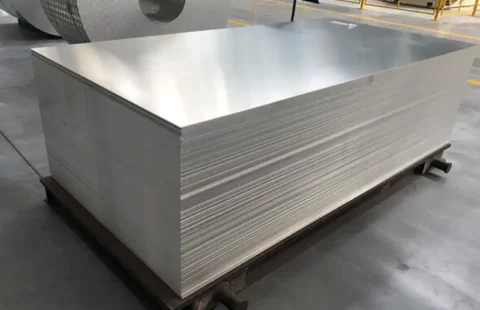
- Sheet Size: Standard sizes are 1220mm×2440mm (4×8 feet).
- Margins: Do you need a solid border around the holes, or should the pattern go to the edge?
- Finish: Do you need it raw, powder-coated, or anodized?
The Future of Perforated Aluminium
As sustainable building becomes the global standard, the demand for perforated aluminium sheets continues to grow. Its ability to provide natural ventilation, reduce energy consumption through sun-shading, and offer a modern aesthetic makes it a “super material” for the 21st century.
Whether you are an architect designing a new landmark or a DIY enthusiast working on a home project, perforated aluminium offers the perfect mix of durability, beauty, and performance.
Frequently Asked Questions (FAQ)
Q: Can perforated aluminium be used outdoors?
A: Yes! Especially if it is anodized or powder-coated, it can withstand rain, snow, and sunlight for decades.
Q: Does perforation make the metal weak?
A: It does reduce the overall strength compared to a solid sheet. However, by choosing the right thickness (t) and alloy, it remains strong enough for most structural and decorative uses.
Q: Is it expensive?
A: The price depends on the complexity of the pattern and the finish. Standard round-hole sheets are very affordable. Custom laser-cut designs cost more.
Leave a Comment
You must be logged in to post a comment.