Aluminium Curtain Wall Australia – Price & Design Guide
In the Australian construction industry, the aluminium curtain wall is the gold standard for modern building exteriors. Whether you are looking at a high-rise in Sydney or a retail hub in Melbourne, these systems provide a sleek, glass-fronted look that is both strong and energy-efficient.
1. What is an Aluminium Curtain Wall?
An aluminium curtain wall is a non-structural outer covering of a building. It is designed to keep the weather out while letting natural light in. Unlike traditional walls, it only carries its own weight and the wind loads. This allows architects to create “all-glass” buildings that look professional and modern.
Table: Basic System Overview
| Feature | Description |
|---|---|
| Frame Material | High-grade Aluminium Extrusions |
| Infill | Double Glazed Units (DGU), Spandrel Glass, or Metal Panels |
| Standard Alloy | $$6063-T5$$ or $$6061-T6$$ |
| Australian Standards | $$AS 2047, AS 1288, AS 4284$$ |
2. Common Types of Curtain Wall Systems
In Australia, two main systems dominate the market. Choosing the right one depends on your budget and the height of the building.
Stick Curtain Wall System
The “Stick System” is built piece by piece on the job site. The vertical and horizontal aluminium mullions are installed first, followed by the glass panels.
- Best for: Low-rise buildings or complex custom shapes.
- Advantage: Lower shipping costs and high flexibility.
- Disadvantage: Takes more time to install on-site.
Unitized Curtain Wall System
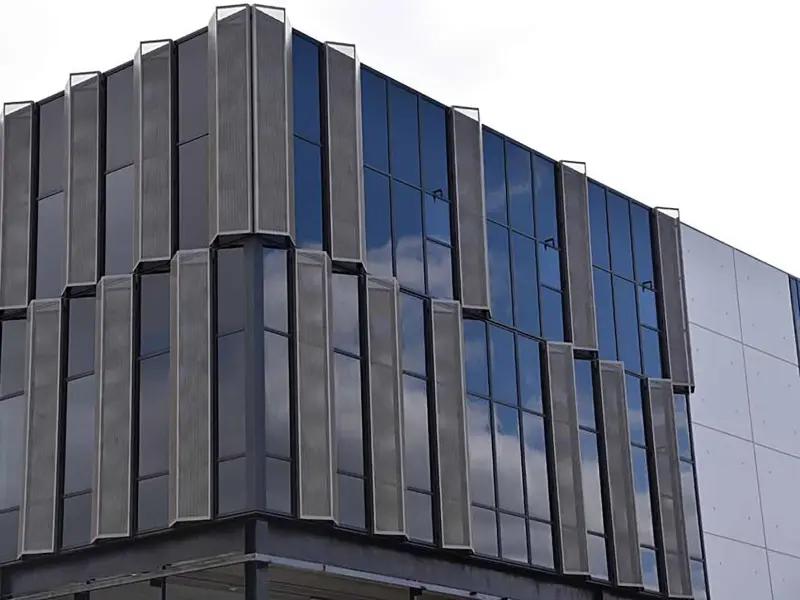
This system consists of large units that are pre-assembled in a factory. These units are then shipped to the site and hung onto the building using cranes.
- Best for: High-rise towers and large-scale commercial projects.
- Advantage: Fast installation and better quality control in a factory setting.
- Disadvantage: Requires more planning and higher transport costs.
Table: Comparison of Stick vs. Unitized
| Factor | Stick System | Unitized System |
|---|---|---|
| Installation Speed | Slow | Very Fast |
| Labour Cost | High (On-site) | Low (On-site) |
| Quality Control | Medium | High (Factory-built) |
| Ideal Height | Up to $$3-4$$ floors | Unlimited / High-rise |
3. Materials and Technical Specifications
The performance of an aluminium glass facade depends on the metal alloy and the type of glass used. In Australia, heat and UV protection are critical.
The Aluminium Frame (Alloy & Status)
Most Australian systems use the 6063-T5 alloy. This alloy is popular because it is easy to extrude into complex shapes and has a very smooth surface for powder coating.
| Property | Value ($$6063-T5$$) |
|---|---|
| Tensile Strength | $$\ge 185 \text{ MPa}$$ |
| Yield Strength | $$\ge 145 \text{ MPa}$$ |
| Hardness | $$\ge 8 \text{ HW}$$ |
| Wall Thickness | $$2.5 \text{ mm} – 3.5 \text{ mm}$$ (Typical) |
Glass and Infill Options
To meet Australian energy ratings (Section J of the NCC), most curtain walls use High-Performance Double Glazing.
- Outer Pane: $$6 \text{ mm} – 8 \text{ mm}$$ Toughened Glass.
- Spacer: $$12 \text{ mm}$$ Argon-filled gap.
- Inner Pane: $$6 \text{ mm}$$ Low-E (Low Emissivity) Glass.
4. Design Considerations for the Australian Climate
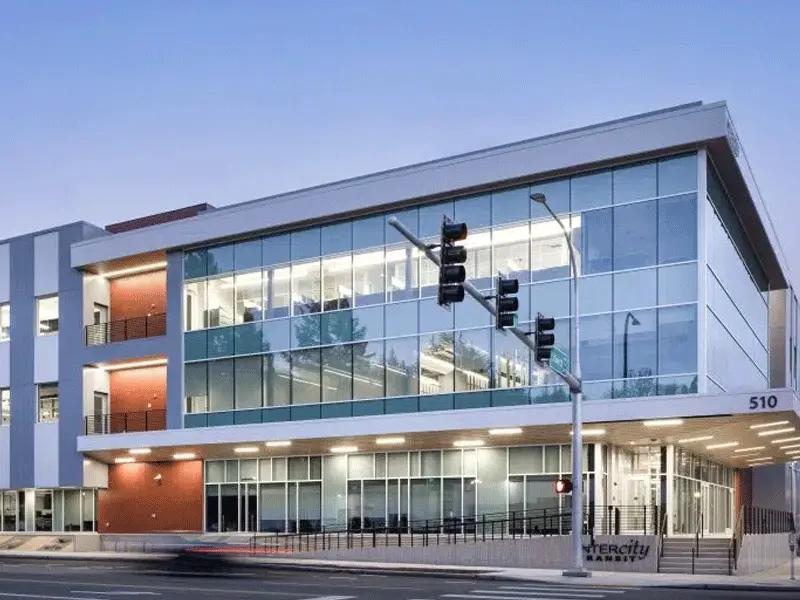
Designing an aluminium glass facade in Australia requires special attention to wind and heat.
Wind Load and AS 1170.2
Australia has specific wind regions (Region A to Region D for cyclones). A curtain wall in Darwin must be much stronger than one in Adelaide. Engineers calculate the thickness of the aluminium mullions to ensure the glass does not break during a storm.
Thermal Performance (Thermal Breaks)
A “Thermal Break” is a plastic strip placed inside the aluminium frame. It stops heat from traveling through the metal. This is essential in cities like Brisbane or Perth to keep the building cool and reduce air conditioning costs.
Water Penetration
The AS 4284 standard tests how well a curtain wall resists water under high pressure. Australian systems use “Pressure Equalization” to ensure water drains out through small weep holes rather than leaking inside.
5. Applications of Aluminium Curtain Walls
Where will you see these systems? They have uses in almost every modern commercial project.
- Commercial Offices: Creating bright, open work environments.
- Retail Centres: High-span glass for shopfronts and malls.
- Hospitals: Durable, easy-to-clean facades that provide natural light for healing.
- Residential Apartments: High-end luxury towers with floor-to-ceiling views.
- Airports and Public Hubs: Large-scale glass walls that handle high wind loads.
6. Curtain Wall Price per m2 Australia
Pricing for a commercial aluminium glass facade varies based on the size of the project and the glass quality.
Table: Estimated Cost Breakdown (AUD)
| System Type | Estimated Price per $$m^2$$ | Notes |
|---|---|---|
| Standard Stick System | $$$800 – $1,100$$ | Clear glass, standard finish |
| Premium Stick System | $$$1,100 – $1,400$$ | High-spec Low-E glass, custom colors |
| Unitized System | $$$1,300 – $1,800+$$ | Includes factory assembly & cranage |
| Refurbishment | $$$1,500 – $2,200+$$ | Removing old walls and replacing |
Note: These prices are estimates. Freight, site access, and custom engineering can change the final quote.
7. Product Types and Finishes
To attract high-end clients, manufacturers offer several finishes for the aluminium frames.
Powder Coating
This is the most common finish in Australia. Brands like Dulux and Interpon offer “Commercial Grade” powders that come with warranties of up to $$25$$ years against fading.
Anodizing
Anodizing thickens the natural oxide layer on the metal. It gives a metallic look (Satin, Bronze, or Black) and is very resistant to scratches and salt air in coastal areas.
Spandrel Panels
Not every part of a curtain wall is clear glass. Spandrel panels are to hide the floor slabs and electrical wires. These can be colored glass or insulated aluminium sandwich panels.
8. Maintenance and Compliance
To ensure a long life for your aluminium glass facade, regular maintenance is required.
- Cleaning: Glass and frames should be washed every $$6$$ months in coastal areas and every $$12$$ months inland.
- Sealant Inspection: Check the silicone seals every $$5$$ years for signs of cracking.
- Compliance: All glass must be installed according to AS 1288. This ensures the glass is the correct thickness to prevent injury if it breaks.
9. Frequently Asked Questions (FAQ)
What is the difference between a window wall and a curtain wall?
A window wall sits between the floor slabs. A curtain wall hangs on the outside of the floor slabs. Curtain walls provide a more continuous “glass look” and better water protection.
How long does an aluminium curtain wall last?
A well-maintained system can last over $$40$$ to $$50$$ years. The aluminium frames will last indefinitely, but the rubber gaskets and silicone seals may need replacing after $$25$$ years.
Is it fire-rated?
Standard aluminium melts at roughly $$660 \text{°C}$$. If your project needs a fire rating, you must include fire-stopping materials at the gap between the floor slab and the curtain wall to prevent smoke from rising between floors.
Can I get a custom color?
Yes. Most aluminium curtain wall australia suppliers can match any color from the Dulux or Interpon charts.
Aluminium Curtain Wall Australia Price
Investing in a high-quality aluminium curtain wall is a smart move for any Australian building project. By choosing the right alloy like 6063-T5 and the correct system for your building height, you can balance beauty, performance, and cost.
Whether you are budgeting for a curtain wall price per m2 Australia project or designing a complex commercial aluminium glass facade, always ensure your supplier meets the relevant Australian Standards. A well-designed facade not only looks great but also adds significant value and energy savings to your property.

Leave a Comment
You must be logged in to post a comment.